Behind the Scenes – Managing Artifact Documentation at the WDM
Moose Jaw North Battleford Saskatoon Yorkton
October 2, 2024
Categories:
Did you know that every WDM artifact has a file of documents held centrally in the WDM’s Corporate Office in Saskatoon?
Artifact files hold documents such as donation agreements, photographs, written histories of the items or the families who owned them, records of repairs and inspections, or correspondence and research materials relating to the artifact. Managing the records for a museum collection takes a lot of work, but it’s something most people rarely have a chance to see or learn about.
As part of the WDM’s 75th anniversary celebrations this year, we’re looking back at how the way we document our Collection has evolved since 1949.
Document storage
Until the WDM’s Corporate Office opened in Saskatoon in 1984, artifact records were held at each museum location. Today, every artifact file is stored at the Corporate Office. In the early days of the WDM, because of the volume of artifacts the WDM was collecting every year, it was difficult to manage the records for so many different objects. By 1977, only a small percentage of the WDM’s Collection had files like these.
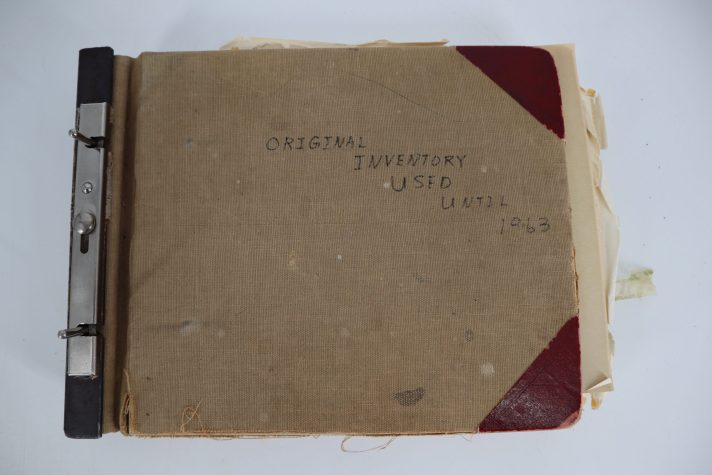
The very first artifacts in the WDM’s Collection were tracked in a large, handwritten ledger. Organized by object type, each page has around 40 lines, with one artifact per line.
Notebooks and catalogue cards were also used to track artifacts and donors in the early years, but these generally recorded only basic information. Usually all that was recorded was what type of object was donated, its accession number and the name of the donor. Legal documents such as transfer of ownership forms were also kept. Eventually, file folders became the primary and default way we store our artifact records.
Originally, these folders were organized either by donor surname (in Yorkton and North Battleford) or by artifact accession number (in Saskatoon and Moose Jaw). An accession number is a unique identifier given to each artifact to make it easier to track and document.

Once the Corporate Office opened, the process of centralizing all records in Saskatoon began, though this wasn’t completed until 2023. Most of these files are now arranged by accession number, though some are still arranged by donor name. All folders will eventually be converted to being labeled and sorted by accession number, but relabeling and reorganizing so many files will take time.
By 2018, the document storage vault in the Corporate Office was home to 27 filing cabinets to store all these folders. However, as the artifact collection continued to grow, space for new records was growing tight. Curatorial staff recognized that storage space would soon run out and began looking for solutions.
In 2019, the WDM received a grant from the Museums Assistance Program, funded by the Department of Canadian Heritage, to have new, high density mobile shelving installed in the storage vault. This new storage system increased storage capacity of the vault to at least three times what it had been able to accommodate before.

The new shelving in the vault has made it easier to look up information on artifacts and ensures that there is ample room for document storage as the WDM artifact collection continues to grow. Maintaining accurate and organized records is important for helping us understand and care for our artifacts, and they help us preserve valuable information on the histories of the objects in our Collection.

