The Restoration of Saskatoon Municipal Railway Snow Sweeper #200: The Edmonton Radial Railway Society and a piece of WDM History
Moose Jaw North Battleford Saskatoon Yorkton
November 21, 2024
Categories:
My reason for visiting was first and foremost to witness the unveiling and inaugural run of one the group’s most recent restorations – a streetcar with a special connection to the Western Development Museum (WDM). This was Saskatoon Municipal Railway (SMR) #200, a combination utility streetcar specifically used for snow sweeping tracks and fixing overhead lines in the heyday of the SMR system in the early 20th century. #200 was formerly a WDM artifact (WDM-1973-S-3145), a long-ago part of our Collection that, in 1986, was sold at public auction and transferred to the ERRS as part of a large deaccession project of 750 artifacts. Its journey is a true deaccessioning success story and a testament to the perseverance of the ERRS volunteers who never gave up on the idea of restoring it.
When the SMR ceased operations in 1951, the City of Saskatoon began divesting itself of its streetcar fleet. Interestingly, Saskatoon had several times purchased its streetcars second hand. #200 was one such streetcar, purchased in 1913 for $1,500 from an unknown owner. Little is known about its first six years. For almost 40 years, #200 served as a little workhorse of a streetcar in Saskatoon, cleaning up after blizzards and fixing overhead lines. By March 1952, the City had approached the WDM about acquiring #200 and another streetcar. While the WDM was interested in the acquisition, it wasn’t a simple transaction. The then new WDM Saskatoon location on 11th Street West was still being configured and was already going to be full of artifacts. Trackage also needed to be built to accommodate the incoming streetcars.

WDM-1973-S-3145. SMR #200 in 1981 at the WDM before ERRS acquired in 1986. WDM File Material.
After several letters back and forth between the Museum and City officials, #200 was finally accepted into the Collection about a year after the initial offer. For many decades, #200 remained part of the WDM’s preservation collection. By the early 1980s, as the WDM was preparing to move a new central storage facility, now known as the Corporate Office, the future of #200 at the WDM was in question.
As part of a wholesale collections assessment research project that started in 1983, #200 was deemed a suitable candidate for deaccessioning with the aim of keeping it in the public domain. As it had been delivered in poor condition to begin with, due to the hard work it had performed for decades, it would have required considerable restoration to bring it back to display condition. Other pressing Museum priorities, and the impending move to the new storage facility, meant that the best thing for this little streetcar was to find it a new home – the ERRS would be that place.

Every element and feature on SMR #200 has been lovingly restored. WDM Photo
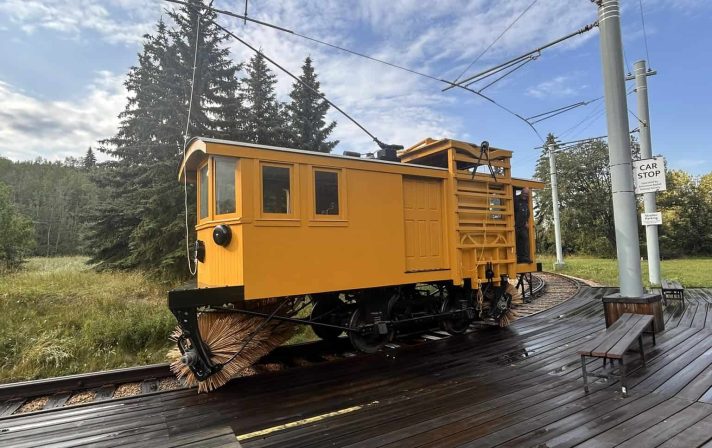
As I approached the freshly painted and fully operationally restored #200, I couldn’t quite believe the level of craftmanship, detail and precise work that had been undertaken for literally decades to restore this streetcar to a drivable condition. Photographs from the file showed a weary version of its former self. It was hard to believe this was the same streetcar. Built in 1907 by the Ottawa Car Company, now 117 years old and clad in bright fresh historically accurate yellow paint, indicative of a safety colour designed to separate it from the passenger fleet of SMR streetcars, #200 stood out as if it were brand new. Complete with fully restored rattan brush rollers that the ERRS volunteers had meticulously shaped by hand and replaced to fit where the old ones had been, this little streetcar looked completely ready for service once again!

ERRS volunteer Pete Kool driving the SMR #200 around the trackage at Fort Edmonton Park. The large motor in the middle of the streetcar drives the snow brushes. WDM Photo
I hoisted myself up into its cabin where ERRS volunteers Bill Keith, Pete Kool and Chris Ashdown explained what was about to happen as we prepared to roll the car out of the barn. We were about to go on a ride of its inaugural loop around Fort Edmonton Park as a completed operational restoration, save for the sweepers and the platform that had yet not been turned on. The ERRS volunteers got me some ear protection to wear as it was going to be loud. Utility streetcars were not built for comfort, they explained. Our ride would be bumpy and clunky, but that was just going to add to the excitement.
#200 is a single truck streetcar propelled by two motors and powered by its overheard line. It was one of eight types of streetcars that ran on the SMR, Saskatoon’s first public transportation system, from 1913 to 1951. It is a track sweeper car with an overhead line tower for repairing electric trolley wires. The hand winch wires come up from a hole in the floor so that the motorman could work overhead. The huge third motor in the middle of the car with a separate controller operates the rattan brooms. There is very little room to walk around the cabin. A couple of small heaters would have kept the motormen warm, but I couldn’t help to think that during a bad storm or a -40 night it would have still been chilly in there. The motorman could drive one end or the other. The brushes operate on a clutch system depending on the direction you’re going. The ERRS volunteers explained that likely two people ran utility streetcars like #200 – one driver and one to operate the brooms. Because these functions run on separate controls it would have been impossible to run them both at the same time with only one pair of hands. The last operators in the barn on a snowy day were generally the people who would have run these streetcars. As the last service came in, the motormen would be asked to do some overtime from midnight to 6:00 am (probably split into two shifts). In the day, the streetcars kept the tracks fairly clear. So, #200’s job was to work all night to make for a passable morning.
 |
| SMR #200 at work after a blizzard on March 15, 1927 on Central Avenue in Sutherland. Saskatoon Public Library Photo as reprinted in Easten Wayman, Saskatoon’s Electric Transit: The Story of Saskatoon’s Streetcars and Trolley Buses (Hawkesbury, ON: Railfare Enterprises Ltd., 1988), 30. |
According to streetcar historian Easten Wayman, #200 set to work from day one of the SMR on January 1, 1913. A lot of snow had fallen New Year’s Eve night. An employee by the name of William Bangs was scheduled to run #200 from the barn at 4:00 am to clear the new streetcar tracks for the day’s first service. But a power failure delayed his departure for several hours. Downtown, #200 had no trouble clearing the snow. By the time it got over to Lorne Avenue, however, four-foot high drifts made for a challenging cleaning. Bangs was said to have thought the little streetcar handled it with “relative ease.” Wayman, Saskatoon’s Electric Transit, 10.
As we made our way around Fort Edmonton Park, I watched as the ERRS volunteers expertly drove #200 around its loop. It wasn’t easy. Significant specialized streetcar knowledge is needed to maneuver these old streetcars around the tracks, to watch for hazards like poles (all the streetcars are different widths), and to feel out the complexities and personalities of each streetcar – they are each one unique and full of character. It was a thrilling ride to say the least!

The research bulletin boards showing blueprints, archival information, photographs and plans for the restoration of the SMR #200 snow sweeper at the ERRS barns at Fort Edmonton Park. WDM Photo.
Back in the barns I met Arnold Rumbold. Arnold was working on drafting scale drawings of #200. Arnold is 90+ years young. Working on streetcar restoration projects is an important way he gives back to his community. The drawings were incredibly detailed, like blueprints. Arnold sat in a workspace in the barn, surrounded by comprehensive research materials about #200 and its history. Two bulletin boards full of material had been sourced from archives across North America as well as the ERRS’s own archive in Old Strathcona to create not just an information hub about the #200 restoration but a visionary storyboard of the streetcar’s journey. This inspirational space is where Arnold comes to complete the drawings of the restored streetcars. Meeting people like Arnold, who bring a wealth of knowledge and expertise to heritage projects, was as inspirational as the restoration of #200 itself.

Edmonton #33 ready for a trip across the High Level Bridge. WDM Photo
We spent our afternoon at the High Level Bridge where ERRS runs three restored streetcars, including Edmonton #33 (St. Louis Car Company 1912), very similar to the WDM’s SMR #12 car, a streetcar under current restoration. Edmonton #33 runs seasonally through the summer and on a special Christmas service, across the massive former Canadian Pacific Railway bridge and trackage from Whyte Avenue to Edmonton’s downtown and back again. This is an absolute ‘must-do’ if ever visiting Edmonton, and a thrill to ride on but also to sit back, relax, and take in the beautiful restoration of this streetcar as well. Every detail has been restored, including adding several car advertisements to the upper railing, contributing to what the atmosphere would have been like for riders about 100 years ago. There is nothing like the gentle sway of the streetcar on the tracks, the breeze coming in from the open windows to cool the car down on a hot summer’s day, and a feeling like you’ve stepped back in time to the efficient and smart mode of public transportation that was the streetcar.
I’d like to express my sincere gratitude to ERRS President Chris Ashdown and Secretary Ward Baskett for suggesting we should meet and think about ways the WDM and the ERRS might continue to work together to keep the history of municipal streetcars on the prairies alive for all to enjoy and understand their unique value in our shared urban histories. To the ERRS volunteers, who painstakingly explained small details to me, showed me the types of tools used in restorations, supplier’s names for parts and materials, the archival holdings and patterns made to make new parts, it was a true pleasure and I will be sure to make the ERRS’s sites part of any future trips whenever I find myself in Edmonton again.
To learn more about SMR #200’s restoration journey with ERRS visit:
https://www.edmontonstreetcars.ca/streetcars/saskatoon200
https://www.edmontonstreetcars.ca/progress-on-saskatoon-200
By: Dr. Elizabeth Scott
Chief Curator – Director of Collections & Research
