Names, Numbers and Narratives: Hidden Stories in City Directories, a Three-Part Series. Part 2
Curatorial & Corporate Services Centre Saskatoon
January 27, 2025
Categories:
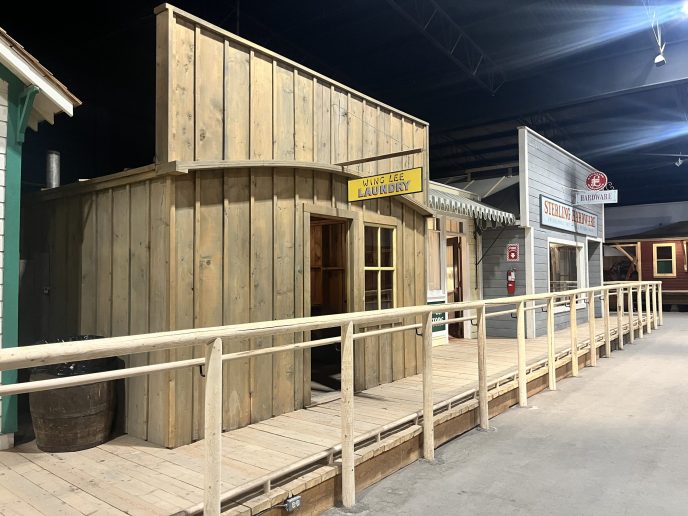
How often do you read the terms and conditions on a website when creating a user profile? If I am honest, I do not thoroughly read the terms; I scan through as fast as possible and happily check the box, indicating that I have read the terms and conditions and am satisfied. I have begun to think about this often as technology changes around me. I even reflected on the subject while researching the Wing Lee Lai Laundry. I started to wonder how much control people in the twentieth century had over their information and its presentation to and for the public.
As I navigated the city directories, searching for the Wing Lee Lai Laundry, I began to make some connections. When I picture collecting information for the city directory in the early twentieth century, I picture someone travelling door-to-door to both business and residential buildings, writing down names and verifying addresses. But what barriers might these collectors encounter, and how do they add to the obstacles while collecting information? This process is more complex than it may seem, and the challenges are intriguing.
The first component I think of is literacy—the ability to spell people’s names correctly, legibly write them down for the next person to read and transfer them to the proper publishing distributors for printing. Not only is the correct transference of information reliant on the collector’s ability to perform all those tasks, but could residents within the city directories verify if their names were spelled correctly? How did a language barrier impact the information collected and its authentic representation for the public consumer? Someone whose first language is not English and who cannot read or write in English would have to have quite a bit of trust to believe that their information was fairly and accurately represented.
The second component I pondered was simple human error. Sometimes, there are spelling errors and house number inconsistencies within the same year of the directory; the business, street or alphabetical sections contradict one another. These human errors impact how a researcher approaches the documents because they must now expand their search terms to reflect multiple spellings and consider inconsistent human error.
Yet, there are other aspects of collecting and displaying information in a city directory that can be firm barriers—societal attitudes of the time can contribute to the discrimination minorities experienced. City directories were no exception.
The first visible instance I came across was the Wing Lee Lai Laundry, described as a ‘Chinese’ Laundry, in the alphabetical section of the 1934 and 1943 city directories.[1] The other Wing Lee Laundries for the years listed were not defined as such, yet they, too, were operated by Chinese proprietors. Was this a conscious choice by the Wing Lee Lai proprietor, Yee Foo, or was this descriptor added by the directory information collector, who may have had their own biases or was influenced by societal attitudes at the time? What impact would this additional descriptor have on the business; would business increase, decrease, or remain the same?
As I considered the potential reasons for adding the directory, I dove into the historical context of the period. What were the societal attitudes like at this time? What laws might have determined discriminatory rules that impacted how minority business owners operated and white settlers interacted with them?
Three significant factors come to mind. Firstly, Chinese laundries were often unfairly labelled as dirty, unsanitary places, unkempt by Chinese bachelors.[2] Secondly, immigration laws that reflected anti-Asian sentiments were still in place. In 1923, a complete ban on immigration from China was enacted. This racist law against Chinese people was not repealed until 1947. The discriminatory representation in the directory serves as a stark reminder of the societal biases that tainted historical data collection.[3]
Lastly, Saskatchewan passed the Female Employment Act in 1912, which required Asian employers to obtain a license to employ white females. This act, along with other discriminatory practices, significantly impacted Chinese employers. In 1919, the provincial law was changed to remove language that specifically targeted employers of Chinese origin, leaving the legislation up to specific municipalities to determine if they wanted to require licenses.[4] Saskatoon opted out of needing a permit to employ white women and girls.[5] With this historical evidence in mind, the questions listed above can be considered in a new light.
However, what truly caught my attention as a researcher was the business section from 1952 to 1956. Starting in 1952, laundries listed in the business section were split into two categories: “laundries” and “Chinese laundries.” But what is most interesting to me is that the laundry located at 336 Ave E South is not labelled as a Chinese laundry within the business section once during this period.[6] The name changed from Wing Lee Lai to Hand Laundry, which will be addressed in the final blog post within this series. Is this due to the name change not reflecting Chinese heritage? Does this have to do with community reputation? How was this decision made?
This differentiation is a stark reminder of the biases present in historical city directories. When left unaddressed, these biases can significantly alter the historical narrative.
Endnotes
[1] Henderson’s Greater Saskatoon Directory 1934, (Winnipeg: Henderson Directories Limited, 1934), 340; Henderson’s Greater Saskatoon Directory 1943 (Winnipeg: Henderson Directories Limited), 478.
[2] Alison R. Marshall, The Way of the Bachelor: Early Chinese Settlement in Manitoba, (Vancouver: University of British Columbia Press, 2011), 24, 64.
[3] Alison R. Marshall, Cultivating Connections: The Making of Chinese Prairie Canada, (Vancouver: University of British Columbia Press, 2014), xi, xii, 7, 13.
[4] Yixi Lu and Li Zong, “The Development of the Chinese Community in Saskatoon,” Canadian Ethnic Studies 49 no. 3 (2017): 74-75.
[5] Accession 2015-019. White Women’s Labour Law – Female Labour in Restaurants and Laundries (127), 1919. Saskatoon City Archives – D500. VI. 230.
Author Biography:
Shannon Putnam was a 2024 summer curatorial intern at the Western Development Museum Corporate Office, working with Chief Curator Dr. Elizabeth Scott as part of Western University’s MA Public History program. Shannon grew up on a Saskatchewan farm but now calls British Columbia home. As a high school teacher, she aims to inspire curiosity in her students and challenge them to question historical narratives and their place within them.
Acknowledgments:
The WDM extends its thanks to Florence Hwang, great-granddaughter of Yee Foo and her family for their assistance on this project. We would also like to thank the City of Saskatoon Archives for their helpful assistance in accessing records related to the Wing Lee Lai Laundry, and to Harris Ford, PhD Candidate in History at the University of Saskatchewan, for sharing his research on Chinese business and histories in Riversdale, Saskatoon


