Names, Numbers and Narratives: Hidden Stories in City Directories, a Three-Part Series. Part 3
Curatorial & Corporate Services Centre Saskatoon
February 3, 2025
Categories:
Growing up, I loved looking through the Sears catalogue, especially around the Christmas holiday season. I made my wish list for the holidays, dreaming of the toys plastered on the newsprint pages in my hands becoming more than a picture on a page—real toys scattered on the floor for me to play with.
For me, the catalogues contained dreams and desires of my childhood. Yet, as I researched the Wing Lee Lai Laundry and continued to read the Saskatoon city directory, I realized that Sears, or similar catalogues, might not contain a product that someone desires but might be an unobtainable product and even, perhaps, a product that to be feared because it could replace someone’s job and how they earn their livelihood.
In 1959, five laundry services existed on the pages of Saskatoon’s city directory, with only two of those services listed in the business section of the directory.[1] In 1960, three self-serve and coin-operated laundry facilities opened their doors: Easy Self-Serve Laundry, Coin-O-Matic Laundry and Coin-op Laundry.[2]
A boom of self-serving laundry machines had begun to take over Saskatoon’s laundry customer base. But how did we get here? Did the directories provide any foreshadowing before the visible boom of 1960 and 1961? Yes, I believe the directories did.
Figure 1 includes the list of laundry services in 1961. Looking closely, you can see that the laundry at 336 Ave E South—previously commonly known as the Wing Lee Lai Laundry—has changed its advertising name to “Hand Laundry.” Why would Yee Foo and his business partners make this shift? One cannot know for sure, but as I began researching, I considered theories and speculated.
How businesses advertise to their customers matters, even in city directories. The Wing Lee Lai Laundry underwent a name advertisement shift earlier than the first appearance of self-operated laundromats. In 1950, Wing Lee Lai Laundry included an additional descriptor for their business: “hand laundry.”[3] Why would the Wing Lee Lai laundry include “hand laundry” earlier than initially anticipated? Could it strictly be due to the price of a hand laundry business license, or were there other reasons for this shift? At this point, there were no coin-operated or self-service laundries in the city directory. Still, larger laundry businesses could capitalize on a more extensive customer base because they were not smaller operations with only a couple of employees who worked and lived out of the same establishment – Modern Laundry on 1st Avenue North is an excellent example.
So, how does one keep their clientele while competing with technological innovation? Is an advertisement shift to hand laundry an indication of care for garments—more significant attention to detail and more effort to provide quality service than an automated machine at home? Saving time for the average consumer, whether a bachelor or a spouse performing domestic labour in a home.
I then ventured into my childhood catalogues: Eaton’s and Sears. As I examined the worn, crinkly pages of a 1955 issue of Eaton’s, I scoured the pages for advertisements for in-home washing machines. I wanted to see the cost of an in-home washing machine and how the catalogues marketed washing machines as an investment for the home. Would it have been possible for the Wing Lee Lai laundry to switch from hand services to more automated ones before the boom of coin-operated facilities?
In 1955, Eaton’s spring and summer catalogue, Eaton’s Viking Automatic Laundry equipment boasted an economy model with an “electric discharge pump,” a “quiet belt-driven mechanism” and a newly designed “Gyrator.”[4] With an upfront payment of $119.50 or a $5 deposit with a monthly payment plan. Regardless, the Viking Economy Model was an “Eaton brand [for] your assurance of value and satisfaction.”[5] That was just the economic model. There were more expensive models available. Using an inflation calculator, the 1955 Viking washing machine would cost approximately $1,400 in the 2024 economy.
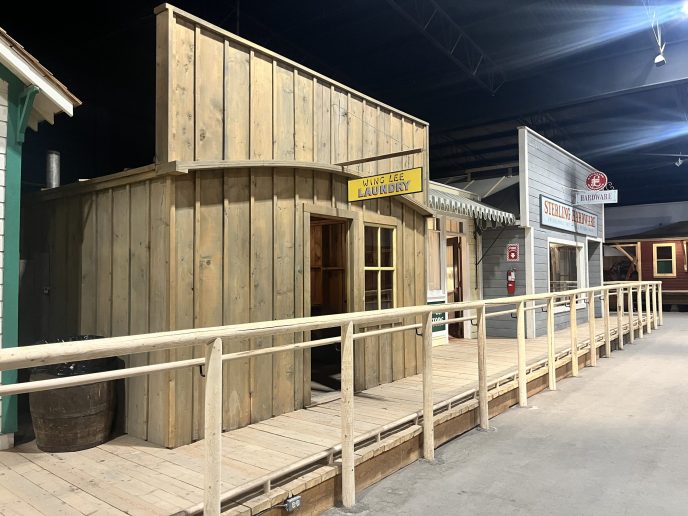
Suppose you have been to the Boomtown exhibit and peeked inside the Wing Lee laundry building. In that case, you can see many tools a proprietor would need to operate their business, such as irons and washing tubs. The cost of shifting from a small run laundry business to keeping up with the technological upgrades would be incredibly challenging. It would be difficult to afford a complete shift fast enough to compete with the newer, more extensive laundry facilities. So, perhaps the only option was to advertise the services offered through a new lens – a more personal lens of care and precision – a hand laundry service.
Technological innovation has been a fantastic investment for some, but it always comes with a cost. In the case of hand laundries, offering quality services at low prices, proprietors were forced to close their doors to their community. What was lost was the intimate community engagement, the face-to-face connection of familiarity. This is not to say that self-serving laundromats do not have their perks because they do. But to me, what is most interesting is the legacy that has been left behind and, to some degree, has led to this summer project. The Wing Lee Lai Laundry was the last hand laundry to close its doors in Saskatoon in 1967.[6] The building shortly afterwards was demolished, but before it was, items from Yee Foo’s laundry were donated to the Western Development Museum, with little known about the stories those objects have held onto.[7] Now, we are full circle, beginning to hear the stories that Wing Lee Lai Laundry has held without an opportunity to share. In the coming year, watch for new interpretation in the Wing Lee Lai Laundry on Boomtown Street, featuring Yee Foo’s story.
Endnotes
[1] Henderson’s Saskatoon Directory 1959, (Winnipeg: Henderson’s Directories Limited, 1959), 806.
[2] Henderson’s Saskatoon Directory 1960, (Winnipeg: Henderson’s Directories Limited, 1960), 71.
[3] Henderson’s Greater Saskatoon Directory 1950, (Winnipeg: Henderson’s Directories Limited, 1950), 70, 331.
[4] Eaton’s of Canada Spring and Summer 1955 (Toronto: T. Eaton Corporation Limited, 1955), 363.
[5] Eaton’s of Canada Spring and Summer 1955 (Toronto: T. Eaton Corporation Limited, 1955), 363.
[6] “Washdays end of Wing Lee,” Saskatoon Star-Phoenix, 25 March 1967, 4; Henderson’s Saskatoon, (Saskatchewan) City Directory 1968, (Winnipeg: Henderson’s Directories Limited, 1968), 109.
[7] Accession 2015-019. Demolition Request 336 Ave E South – Plan C E Block 20 – Scanned 02/12/98. City of Saskatoon Archives – D00-VI-230.
Author Biography:
Shannon Putnam was a 2024 summer curatorial intern at the Western Development Museum Corporate Office, working with Chief Curator Dr. Elizabeth Scott as part of Western University’s MA Public History program. Shannon grew up on a Saskatchewan farm but now calls British Columbia home. As a high school teacher, she aims to inspire curiosity in her students and challenge them to question historical narratives and their place within them.
Acknowledgments:
The WDM extends its thanks to Florence Hwang, great-granddaughter of Yee Foo and her family for their assistance on this project. We would also like to thank the City of Saskatoon Archives for their helpful assistance in accessing records related to the Wing Lee Lai Laundry, and to Harris Ford, PhD Candidate in History at the University of Saskatchewan, for sharing his research on Chinese business and histories in Riversdale, Saskatoon.


