Taking Charge of Health – A Brief History of Electroconvulsive Therapy in Saskatchewan
Curatorial & Corporate Services Centre
February 24, 2025
Categories:
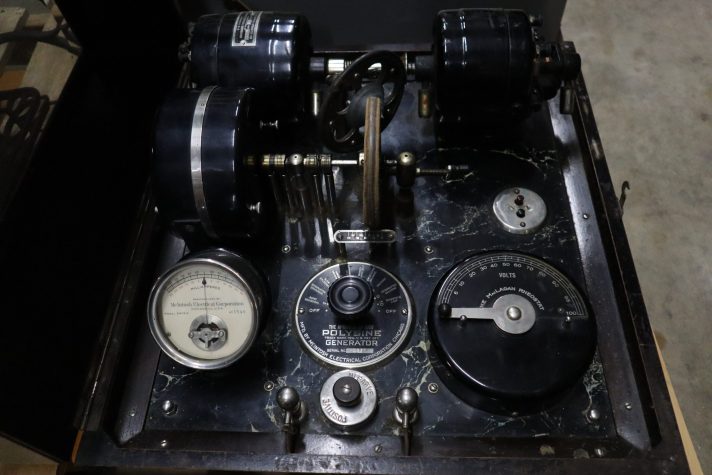
While working on our ongoing Fire Code Compliance Project, Arden, one of our volunteers, and I were busy inventorying another batch of artifacts. As we went through the items, we came across something unusual. At first, it looked like a large, opaque box with a murky glass lid. Inside was a mix of steel parts, wiring, and coils. Intrigued, Arden and I decided to dig a little deeper into its file to find out more. Little did I know, what started as a simple curiosity would turn into a much larger discovery—one that would leave us both stunned on a quiet Thursday afternoon.
It turned out the artifact was a “shock box,” a device used in Electroconvulsive Therapy (ECT), a treatment that first emerged in Italy in 1938 and made its way to Canada in 1941. ECT was once commonly used to treat severe mental illnesses, like schizophrenia and depression. At first, we didn’t know much about its history, but as we read on, we discovered that Saskatchewan had a unique connection to it, especially in the city of Weyburn.
The Weyburn Mental Hospital, which opened in 1921, became one of Canada’s most prominent psychiatric institutions. In the 1950s, it was a hotbed of mental health innovation, largely driven by doctors like Dr. Humphry Osmond and Dr. Abram Hoffer. While they are best known for their work with psychedelics—it’s actually where the term “psychedelic” was coined—ECT was also a key part of their treatment arsenal, not just in Weyburn but also at the North Battleford Hospital.
By the 1970s, though, ECT started to face growing criticism. With the stigma surrounding mental health at the time, media portrayals painted the treatment as cruel and torturous. Concerns about its overuse, potential side effects (like memory loss), and issues of consent led to a decline in its use. Mental health care shifted toward more patient-centered approaches, with ECT reserved for extreme cases where other treatments had failed.
Despite its controversial past, ECT is still used today. While it has been both criticized and defended in the media over the years, the treatment has evolved. It’s more regulated and refined than it was in its early days, and it remains an effective practice, especially for those suffering from severe mental health conditions. In a way, it’s a bit of a paradox—still controversial, yet still used because it works. And for those who need it most, that makes all the difference.
This wasn’t the heavy subject Arden and I thought we’d be diving into that day, but it reminded me of something important. The path toward better mental health care is often a bumpy one. Sometimes, to make progress, we need to look back, understand the past, and use that knowledge to guide us toward a better future.
By Dall Perkins
Young Canada Works Building Careers in Heritage Intern
Arden Anderson
Museum Volunteer
