Moving a Collection – Part Two
Moose Jaw North Battleford Saskatoon Yorkton
April 13, 2022
Categories:
Overcrowding
Overcrowding of artifacts can cause damage through a variety of ways. The greatest concern with documents is folding and tearing of the paper caused by improper handling of the artifacts. It is easier to handle artifacts safely when they can be approached a few at a time. Damage can also occur if a storage box is too full, causing documents to become misshapen.

These photos are overcrowded all in one folder which poses a risk to the long-term preservation of the images. Click to enlarge
Incorrect Support
Providing proper support to artifacts in storage helps protect them from damage of the most rampant physical force around, gravity. While we don’t notice the damage gravity can cause in our daily life, when objects are in storage for long periods of time the damage becomes evident. It is important not to allow materials to slump over in a half empty box or rest on a support that is smaller than the artifact.
 This package of envelopes has been poorly supported, which has resulted in the distortion of the paper. WDM-1978-S-2541. Click to enlarge |
 This box may only be partially filled, but this support keeps all the documents straight providing excellent support. Click to enlarge. |
Storage Materials
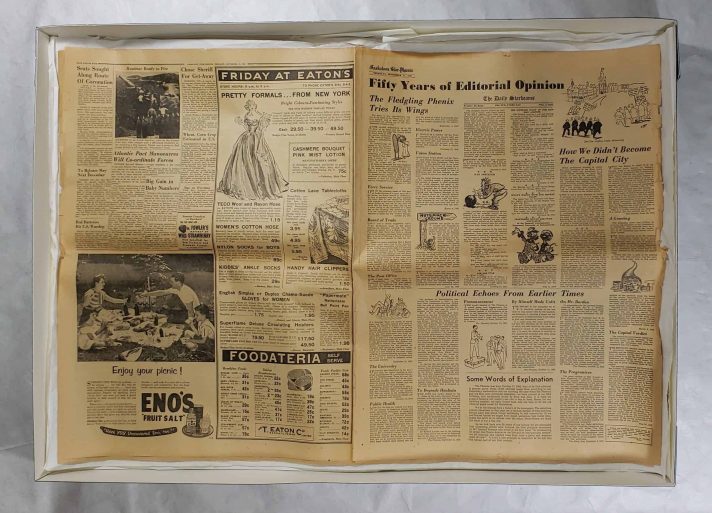
Because museums look to preserve artifacts and the stories behind them for future generations, they are particular about the materials utilized to store artifacts in. Conservators look to make sure storage materials will not cause damage to artifacts. For document storage, conservators recommend using paper-based storage materials, which are acid-free and lignin-free. Paper is naturally acidic and ensuring the products used to store documents are acid-free ensures storage materials are not damaging the artifacts. For highly acidic paper products, such as newspaper, conservators recommend the use of buffered products. Buffered storage materials contain an alkaline (basic) reserve, which helps to neutralize the acids that may leach from the document and result in damage to the artifacts.

The storage materials for these newspapers needs to be replaced with boards and tissue paper that contain a buffering agent to help neutralize acids, which may leach from the newspapers. Use of buffered paperboards will all give the sections better support and make it safer for collections staff to remove the artifacts from the box. WDM-2002-S-685. Click to enlarge
Each artifact is different, which requires staff to consider a variety of options when implementing changes to how they are housed. While such changes may seem small, they make a big impact on the long-term preservation of the museum’s artifacts.
Stay tuned for Part 3 where we will look at creating the correct environment to slow the speed of deterioration.
By: Jill Baron, Curatorial Assistant
